

Lateral Elbow Pain is Often Associated with Trigger Points
Trigger points are really common in the elbow and forearm muscles; this may well be connected to our increased sedentary and technology-based lifestyles.
Needless to say, as hands-on therapists, we too often get tense and stiff forearm muscles.
Why trigger points? Our body tries to protect us. It wants the trauma to heal and often “switches-of” around “damaged tissue.”
Trigger points are a key part of this protect-and-defend mechanism. However, if a problem isn t managed correctly, it can crescendo and the trigger points become deep seated, causing the host muscle to be shorter, tighter, and less efficient.
In addition, trigger points also add to the cycle of increased sensory input to our peripheral and central nervous system (sensitisation), which can lower the threshold for pain.
In other words, if left untreated, trigger points can feed into the nervous system and prevent full recovery.
Trigger Point Treatment
Treatment will often include deep tissue massage therapy, muscle stretching, heat and ice, and kinesio taping.
When treating trigger points, many practitioners will also apply dry needling (medical acupuncture) and vacuum or static cupping
Tennis Elbow
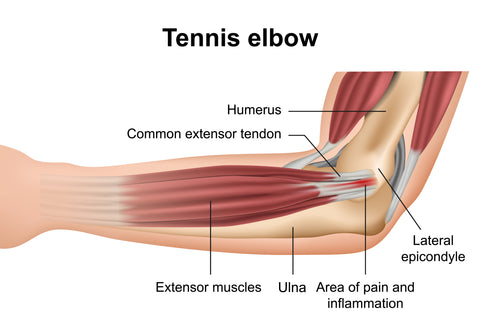
Tennis Elbow – Lateral Epicondylitis (lateral elbow pain on gripping) can start as an annoying ache but rapidly degenerate into a debilitating problem, with pain on gripping, opening bottles, or even on shaking hands.
Unless they have had it, people simply don t understand how bad it can be. The pain from a tennis elbow is often associated with trigger points in the muscles of the lateral epicondyle of the elbow, especially the Lateral Head of Triceps and the Extensor Carpi Radialis Brevis tendon (1-2 cm distal to its attachment on the lateral epicondyle).
As shown in the video above, trigger points in the extensor carpi unlaris are also often implicated in lateral elbow pain.
LE is more common than Medial Epiconylalgia (Golfer's Elbow) by a ratio of 9:1.
Although mostly referred to as Lateral Epicondylitis, LE is generally NOT an inflammatory condition.
Microscopic evaluation of the tendons does not show signs of inflammation, but rather angiofibroblastic degeneration and collagen disarray.
Light microscopy reveals both an excess of fibroblasts and blood vessels that are consistent with new blood vessels (angiogenesis).
It is most often due to repetitive micro-tears in the zone, especially where the tendon of the muscle meets the bone (musculotendinous junction).
This is because the tendons are relatively hypovascular close (proximal) to the tendon insertion.
This blog is intended to be used for information purposes only and is not intended to be used for medical diagnosis or treatment or to substitute for a medical diagnosis and/or treatment rendered or prescribed by a physician or competent healthcare professional. This information is designed as educational material, but should not be taken as a recommendation for treatment of any particular person or patient. Always consult your physician if you think you need treatment or if you feel unwell.


