


Wrist Flexors
Wrist Flexor Trigger Points - Dr. Jonathan Kuttner
The wrist flexors definitely tend to fall into that category of important muscle that most of us tend to take for granted.
The wrist flexors are busy working, not just at the gym, but when we are performing common daily tasks such as using mobile phones, gripping a steering wheel or even when we are doing the laundry.
Trigger points build up over time, and may be the precursor to more complex injuries when left untreated. Simple daily stretching may help to prevent the activation of latent trigger points.
Here's a simple stretch that we often recommend. Start by allocating just a minute each day to this stretch.
Try to perform the stretch at least once a day, at the end of a long drive, or perhaps when you get up to take a break from your desk.
Build up from there but, as always, don't push too hard or over-stretch.
If you happen to be a manual therapists, you should be performing this stretch in between each client!
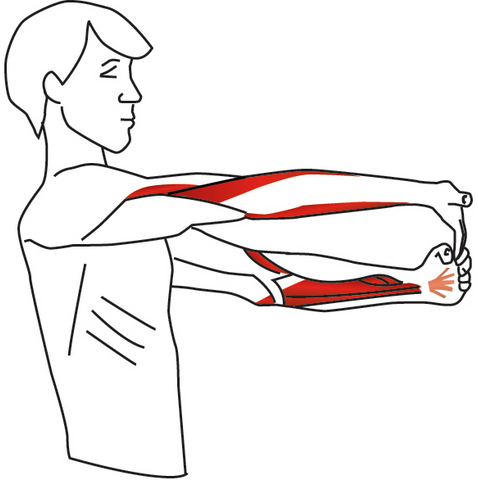
TECHNIQUE
MUSCLES BEING STRETCHED
Primary muscles: Brachialis. Brachioradialis. Pronator teres. Flexor carpi radialis. Flexor carpi ulnaris. Palmaris longus.
Secondary muscles: Flexor digitorum superficialis. Flexor digitorum profundus. Flexor pollicis longus.
INJURY WHERE STRETCH MAY BE USEFUL
Tennis elbow. Golfer’s elbow. Thrower’s elbow. Wrist sprain. Wrist dislocation. Wrist tendonitis. Carpal tunnel syndrome. Ulnar tunnel syndrome.
ADDITIONAL INFORMATION FOR PERFORMING THIS STRETCH CORRECTLY
The forearms, wrists, and fingers comprise a multitude of small muscles, tendons, and ligaments. Do not overstretch this area by applying too much force too quickly.
Links
Find a Trigger Point Professional in your area
More Articles About Elbow Pain
Dry Needling for Trigger Points
Certify as a Trigger Point Therapist


