
Muscle Energy Techniques - Treating Subscapularis
Trigger Points in Subscapularis - it's important to include stretching as part of treatment. MET's may be effective (see below).
Studies have shown that a combination of compression, stretching and Muscle Energy Techniques (MET's) are likely to produce better outcomes when treating trigger points, as compared to compression techniques alone
The term MET was first described in 1948 by Fred Mitchell, Sr., D.O. and MET's are today quite commonly used to treat somatic dysfunction, especially decreased range of motion, muscular hypertonicity, and pain.
MET's are both effective and easy to learn
A large body of work has emerged over the last decade to support the use of MET's, specifically as part of an integrated approach to the treatment of trigger points.
Much credit needs to go to Leon Chaitow for his voluminous works on the subject of MET's, and to John Gibbons whose main work on the subject of MET's forms the core text of the MET master course (and whose example we use below).
The use of MET's has increased exponentially in recent years because they are effective, and simple to learn.
MET's are included in many NAT trigger point treatment protocols and we continue to share data and experience with therapists worldwide.
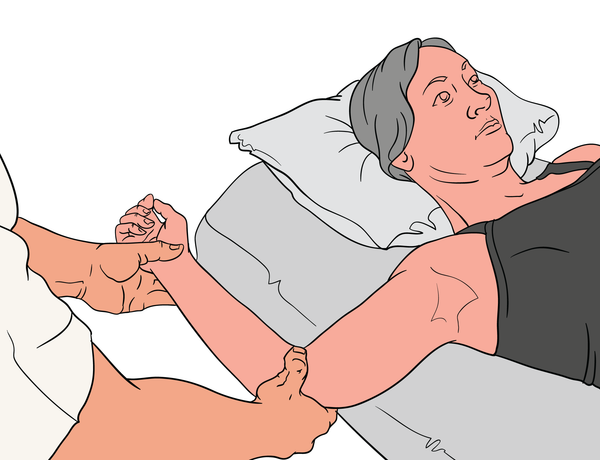
MET treatment of the subscapularis – PIR method. Position of bind of the subscapularis
MET Treatment of Subscapularis (Post-Isometric Relaxation - PIR - Method)
In this example, the therapist takes the client's shoulder into external rotation until a bind is felt.
From the position of bind, the client is asked to contract the subscapularis by internally rotating their shoulder.
After 10 seconds and on the relaxation phase, the therapist applies traction to the shoulder joint (to prevent an impingement) and slowly encourages the shoulder into further external rotation.
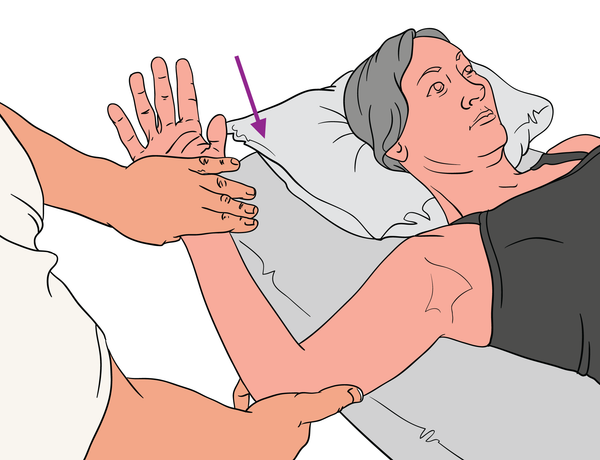
The patient internally rotates the shoulder to activate the subscapularis
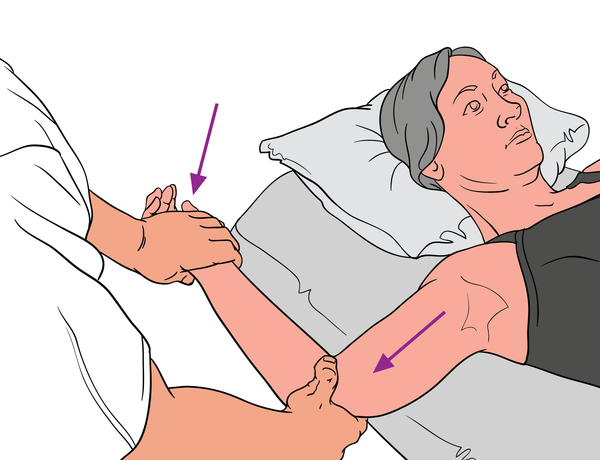
After the contraction of the subscapularis, the therapist applies traction to the humerus and encourages further external rotation
Reciprocal inhibition (RI) Method
If the patient has discomfort activating the subscapularis, the antagonistic muscle of the infraspinatus can be activated instead.
From the position of bind, the client is asked to resist external rotation; this will contract the infraspinatus and allow the subscapularis to relax through RI.
On the relaxation phase, a lengthening procedure of the subscapularis can then be performed.
Find a Trigger Point Professional in your area
Dry Needling for Trigger Points

This trigger point therapy blog is intended to be used for information purposes only and is not intended to be used for medical diagnosis or treatment or to substitute for a medical diagnosis and/or treatment rendered or prescribed by a physician or competent healthcare professional. This information is designed as educational material, but should not be taken as a recommendation for treatment of any particular person or patient. Always consult your physician if you think you need treatment or if you feel unwell.
About Niel Asher Education
Niel Asher Education (NAT Global Campus) is a globally recognised provider of high-quality professional learning for hands-on health and movement practitioners. Through an extensive catalogue of expert-led online courses, NAT delivers continuing education for massage therapists, supporting both newly qualified and highly experienced professionals with practical, clinically relevant training designed for real-world practice.
Beyond massage therapy, Niel Asher Education offers comprehensive continuing education for physical therapists, continuing education for athletic trainers, continuing education for chiropractors, and continuing education for rehabilitation professionals working across a wide range of clinical, sports, and wellness environments. Courses span manual therapy, movement, rehabilitation, pain management, integrative therapies, and practitioner self-care, with content presented by respected educators and clinicians from around the world.
Known for its high production values and practitioner-focused approach, Niel Asher Education emphasises clarity, practical application, and professional integrity. Its online learning model allows practitioners to study at their own pace while earning recognised certificates and maintaining ongoing professional development requirements, making continuing education accessible regardless of location or schedule.
Through partnerships with leading educational platforms and organisations worldwide, Niel Asher Education continues to expand access to trusted, high-quality continuing education for massage therapists, continuing education for physical therapists, continuing education for athletic trainers, continuing education for chiropractors, and continuing education for rehabilitation professionals, supporting lifelong learning and professional excellence across the global therapy community.

Top CE Value Packs
Product list

Tools and Accessories


Continuing Professional Education
Looking for Massage Therapy CEUs, PT and ATC continuing education, chiropractic CE, or advanced manual therapy training? Explore our evidence-based online courses designed for hands-on professionals.

