


From a dynamic postural viewpoint, the soleus prevents the body falling forward at the ankle joint during standing
In gait, the muscle eccentrically decelerates subtalar joint pronation and internal rotation of the lower leg at heel-strike. It also decelerates dorsi flexion of the foot.
Spasm or myofascial trigger points in the soleus can be the origin of achilles pain, tight hamstrings, lower back pain, night cramp, and even headaches.
The soleus typically refers pain into the posterior aspect and plantar surface of the heel and to the distal end of the Achilles tendon.
A rare myofascial trigger point spreads pain to the ipsilateral sacroiliac joint, and can also refer pain to the jaw in extreme cases.
Anatomy
Part of the triceps surae. The soleus is so called because its shape resembles a fish. The calcaneal tendon of the soleus and gastrocnemius is the thickest and strongest tendon in the body.
Origin
Posterior surfaces of head of bula and upper third of body of bula. Soleal line and middle third of medial border of tibia. Tendinous arch between tibia and bula.
Insertion
With tendon of gastrocnemius into posterior surface of calcaneus.
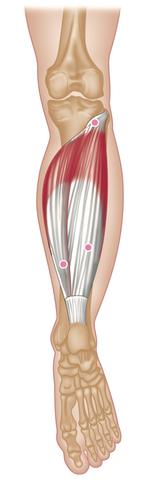
Soleus - Common Trigger Point Sites
Action
Plantar flexes ankle joint. Frequently in contraction during standing, to prevent body falling forward at ankle joint, i.e. to offset line of pull through body’s center of gravity, thus helping to maintain upright posture. Antagonist: tibialis anterior.
Nerve
Tibial nerve, L5, S1, 2. BASIC FUNCTIONAL
Movement
Example: standing on tiptoes.
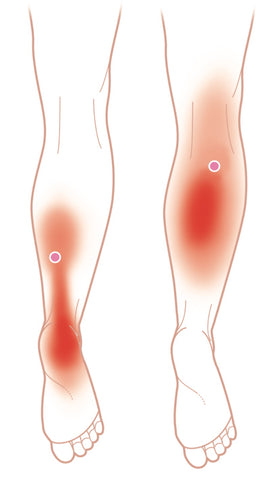
Soleus Trigger Points - Common Referred Pain Patterns
Trigger point referred pain patterns
Pain in distal Achilles tendon and heel to posterior half of foot. Calf pain from knee to just above Achilles tendon origin. 4–5 cm zone of pain in ipsilateral sacroiliac region (rare).
Indications
Calf/heel/posterior knee pain, chronic/long-term use of high-heeled shoes, planter fasciitis, chronic calf shortening, calf pain walking stairs, low back pain, leg cramps.
Causes
Post-fracture splinting, poor orthotics, prolonged driving, sports (e.g. running, soccer, cycling, climbing, skiing, rowing machine), footwear (high heels), PSLE, occupational standing, direct blow/ trauma, pressure on calf.
Differential Diagnosis
Achilles tendonitis. Compartment syndrome. Vascular disease.
Heel spur. Fasciitis. Subtalar joint problems. Venous pump mechanisms. Tendon rupture. Baker’s cyst. Shin splints. Stress fracture. Leg length discrepancy.
Connections
Popliteus, gastrocnemius, tibialis posterior, quadratus plantae (of foot), abductor hallucis (of foot), piriformis, occasionally to jaw.

You probably won't be able to reach the trigger point with a tennis ball but massage to the area with a tennis ball might help

Soleus Trigger Points can be self treated but the muscle is deep and pressure tools should not be used without instruction from a professional.
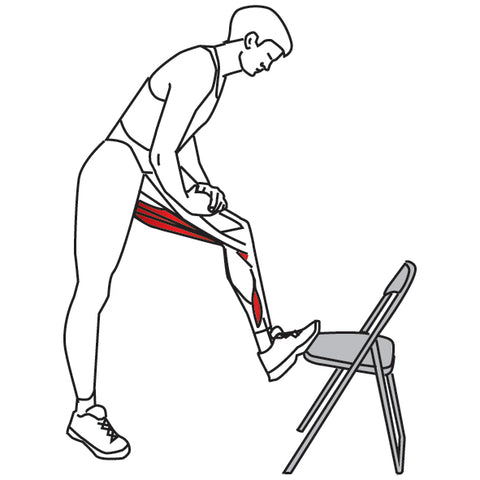

Stretching can be useful and there are many simple stretching exercises for the soleus that anyone can perform at home without special equipment
Self Help
Self-massage techniques can be helpful; you can even use the opposite knee. Balls and pressure tools may be used but not by the novice, as the muscle is deep and there are many superficial and deep veins in the area.
Stretching is excellent for disabling trigger points in the calf muscles. Use of foam rollers can be effective.
General Advice
Change footwear. Change and vary running techniques/running surface. Change/avoid high-heeled shoes. Regular stretching. Leg rests at home and at work. Use of cold. Massage after sports, with warm up before and cool down after. Posture.
Links
Dry Needling for Trigger Points
Certify as a Trigger Point Therapist


