Treating Trigger Points in the Wrist Flexors
How overuse, growth plates, and modern youth pitching demands are putting young elbows at risk
Youth baseball is bigger, faster, and more competitive than ever. Many young athletes now play on school teams, travel teams, tournament teams, private training programs, and offseason showcases. The result is a lot of throwing for bodies that are still growing.
That matters because a child’s elbow is not simply a smaller adult elbow. In young athletes, the growth plates are still open and vulnerable. Repeated throwing stress can irritate or damage the inside of the elbow, leading to what is commonly called Little League elbow.
What Is Little League Elbow?
“Little League elbow” is an umbrella term for elbow pain and injury in young throwing athletes. It most often affects baseball pitchers, but catchers, infielders, softball players, javelin throwers, and other overhead athletes can also develop symptoms.
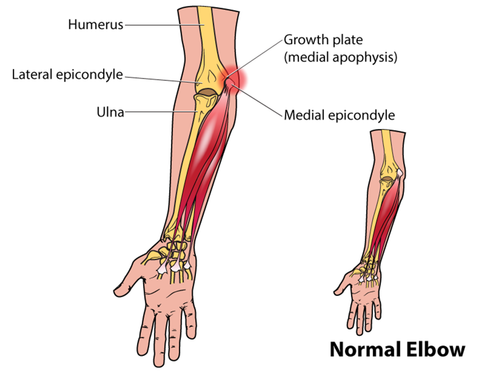
The classic injury involves the medial epicondyle, the bony prominence on the inside of the elbow. In children, this area includes a growth plate. Repeated throwing creates valgus stress, meaning the elbow is forced inward while the inside structures are pulled apart. Over time, this can lead to irritation, widening, fragmentation, or even an avulsion injury of the growth plate.
Related diagnoses may include:
- Medial epicondylar apophysitis
- Medial epicondyle fracture
- Ulnar collateral ligament irritation or injury
- Flexor-pronator muscle overload
- Capitellar compression injuries on the outside of the elbow
Why the Problem Is Growing
The original concern around Little League elbow was overuse. That has not changed. What has changed is the environment around young athletes.
Today’s players often throw year-round, pitch for more than one team, attend velocity-focused training sessions, and chase radar-gun numbers before their bodies are mature enough to tolerate the load. Recent reporting on baseball injuries has also highlighted how the modern emphasis on velocity and maximum-effort throwing is influencing players at younger ages.
Pitch count rules help, but they do not capture everything. Warm-up throws, bullpen sessions, throws from other positions, private lessons, showcases, and tournament weekends all add stress. A player may technically follow the rules in one league while still accumulating too much total throwing across the week or year.
Signs and Symptoms
Young athletes should not be encouraged to “push through” elbow pain. Warning signs include:
- Pain on the inside of the elbow during or after throwing
- Swelling or tenderness around the elbow
- Loss of throwing velocity or accuracy
- A stiff or locked feeling in the elbow
- Difficulty fully straightening the arm
- A popping, catching, or sharp pain during a throw
- Symptoms that return every time throwing volume increases
Persistent elbow pain in a growing athlete deserves evaluation by a sports medicine professional, especially if symptoms last more than a few days, affect motion, or appear with a sudden pop.
How It Happens
Throwing is a whole-body movement. The legs, hips, trunk, shoulder, elbow, wrist, and hand all contribute to force transfer. When the lower body, trunk, or shoulder is not doing enough of the work, the elbow often takes more stress.
During the late cocking and acceleration phases of throwing, the inside of the elbow experiences traction while the outside of the elbow experiences compression. In an adult, this may overload the ulnar collateral ligament. In a child, the growth plate may be the weaker link.
This is why Little League elbow is not only an “elbow problem.” It is often a workload, recovery, strength, mobility, and mechanics problem.
Treatment: First, Protect the Growth Plate
The first step is usually stopping throwing long enough for pain and tissue irritation to settle. Boston Children’s Hospital notes that many young athletes are treated with rest and physical therapy, with no throwing until healing has occurred, often around six to twelve weeks depending on severity.
A sensible care plan may include:
- Temporary removal from throwing
- Ice for short-term pain and swelling
- Medical assessment when pain is persistent, severe, or associated with loss of motion
- Physical therapy to restore range of motion, strength, and throwing mechanics
- A gradual, supervised return-to-throwing program
- Review of pitch counts, team overlap, mechanics, and yearly workload
More serious injuries, including fractures or displaced growth plate injuries, may require surgical care. That is why early assessment matters.
Where Trigger Point Therapy Fits
Trigger point therapy can be a useful supportive tool, particularly when the flexor-pronator muscles of the forearm are overworked and painful. These muscles help flex the wrist, pronate the forearm, and support the inside of the elbow during throwing.
In clinical practice, manual therapy may help reduce protective muscle tone, improve local comfort, and support better movement quality. Common areas of focus may include:
- Wrist flexors
- Pronator teres
- Flexor carpi ulnaris
- Flexor carpi radialis
- Biceps and brachialis
- Shoulder rotator cuff and scapular stabilizers
However, trigger point therapy should not be used as a way to keep a child throwing through pain. If a growth plate injury, fracture, UCL injury, or joint pathology is suspected, the athlete needs appropriate medical evaluation. Manual therapy is best viewed as part of a broader rehabilitation plan, not a substitute for diagnosis, rest, or load management.
When treating children, practitioners should obtain parental consent, explain the treatment clearly, work within professional scope, and offer a chaperone.
Prevention: The Practical Checklist
The best treatment is prevention. Current youth pitching guidance emphasizes workload limits, rest, and year-round monitoring.
Key principles:
- Follow age-based pitch count limits.
- Track pitches across all teams, not just one league.
- Avoid pitching on consecutive days.
- Avoid playing catcher immediately after heavy pitching.
- Build in several months away from overhead throwing each year.
- Do not ignore pain, loss of motion, or velocity drop.
- Encourage multi-sport development instead of early single-sport specialization.
- Prioritize mechanics, strength, mobility, sleep, and recovery over radar-gun numbers.
Little League’s current baseball pitch limits are 50 pitches per day for ages 6-8, 75 for ages 9-10, 85 for ages 11-12, and 95 for ages 13-16. MLB Pitch Smart provides similar age-based guidance and rest recommendations.
Return to Throwing
A young athlete should return to throwing only when they have:
- No pain at rest
- No tenderness at the elbow
- Full elbow range of motion
- Restored shoulder, trunk, and forearm strength
- Medical or therapy clearance when symptoms were significant
- A gradual throwing progression
Returning too quickly is one of the most common reasons symptoms recur. The goal is not simply to get the athlete back on the mound. The goal is to help them keep playing safely for years.
The Takeaway
Little League elbow is a warning sign, not a badge of toughness. A sore elbow in a young thrower may reflect growth plate stress, muscle overload, poor recovery, or a more serious structural injury.
Trigger point therapy and soft-tissue work can play a valuable role in easing muscular contributors around the forearm, shoulder, and kinetic chain. But the larger solution is smarter: listen early, reduce load, protect growth plates, rebuild strength, and make sure the child’s long-term health matters more than the next inning.