

Abdominal Pain and Trigger Points
External Oblique Muscles
Similarly to the other abdominal muscles, external oblique myofascial trigger points can refer pain anywhere locally throughout the abdominal region.
This pain is often exacerbated during the menstrual cycle. Pain can refer down into the groin and sometimes to the testicles.
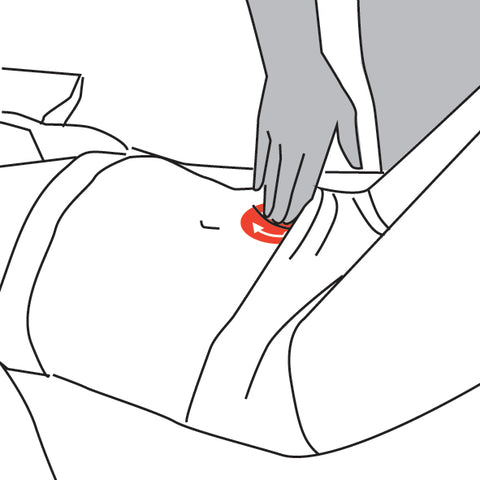
Anatomy
The posterior fibers of the external oblique are usually overlapped by the latissimus dorsi, but in some cases there is a space between the two, known as the lumbar triangle, situated just above the iliac crest.
The lumbar triangle is a weak point in the abdominal wall.
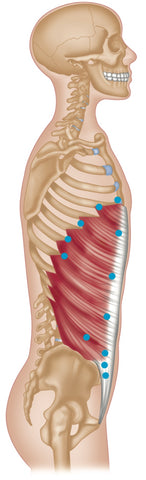
External Oblique Muscle - Common Trigger Point Sites
Origin
Lower eight ribs.
Insertion
Anterior half of iliac crest, and into an abdominal aponeurosis that terminates in the linea alba (a tendinous band extending downward from the sternum).
Action
Compresses abdomen, helping to support abdominal viscera against pull of gravity. Contraction of one side alone bends trunk laterally to that side and rotates it to opposite side.
Nerve
Ventral rami of thoracic nerves, T5–T12.
Basic Functional Movement
Example: digging with a shovel.
Trigger Point Referred Pain Patterns
Viscerosomatic.
Costal margin: abdominal pain to chest.
Lower lateral: testicular pain. Local pain.
Pubic rim: bladder pain. Frequency/ retention (urine). Groin.
|
"Pain can refer down into the groin and sometimes to the testicles" |
Indications
Abdominal pain and tenderness, groin pain, testicular pain, bladder pain, nausea, colic, dysmenorrhea, diarrhea, viscerosomatic pain, irritable bowel syndrome, lower crossed pattern, bedwetting in children.
Common Causes
Direct trauma (commonly from overexertion during sports), poor sit-up technique, prolonged cross- legged sitting, coughing, emotional stress, may be related to back pain, post-surgical (abdominal).
Differential Diagnosis
Visceral pathology including: renal, hepatic, pancreatic, diverticular disease, colitis, appendicitis, hiatus hernia, peritoneal disease—pelvic inflammatory disease, ovarian, bladder.
Connections
Transversus abdominis, internal oblique, rectus abdominis, pyramidalis.
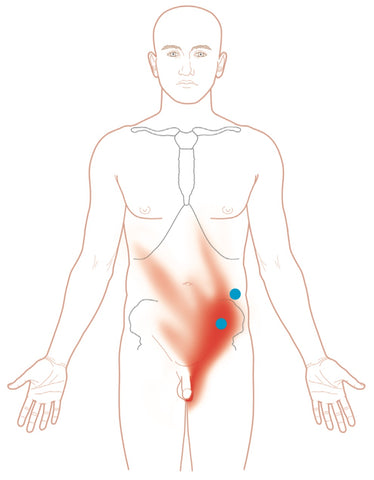
External Oblique Trigger Points - Typical Referred Pain Pattern (Lower Fibers)
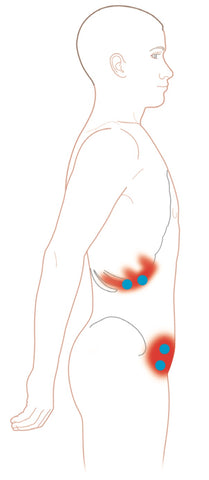
External Oblique Trigger Points - Typical Referred Pain Pattern (Lateral view, upper and lower fibers)


