

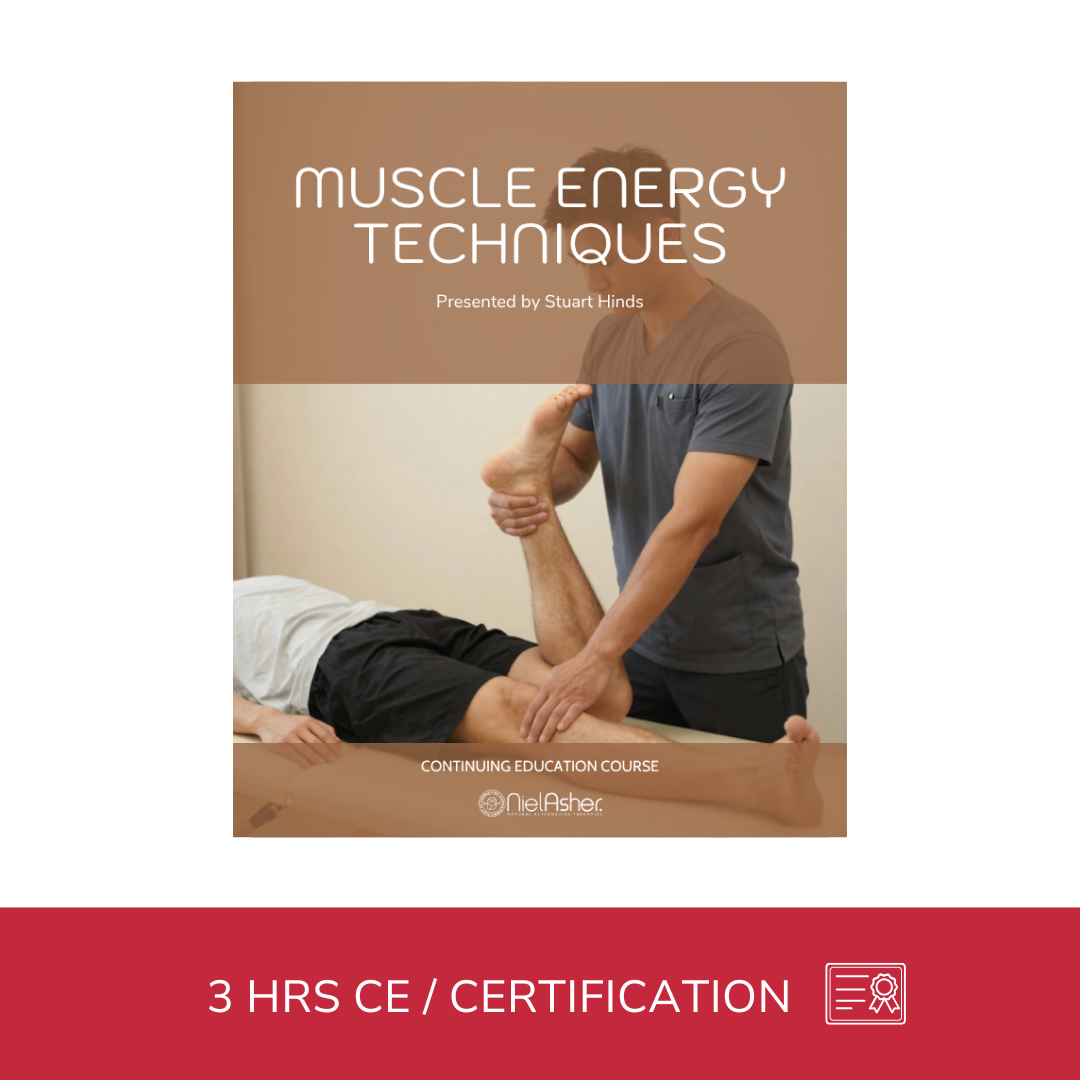


Muscle Energy Techniques (3 hrs)
Muscle Energy Techniques
3 Hours CE/CPD | Online Course with Stuart Hinds
A practical, professionally focused course exploring Muscle Energy Techniques as a gentle, collaborative approach to improving movement, reducing muscular tension, and supporting better neuromuscular control.
Muscle Energy Techniques is presented by Stuart Hinds, an internationally respected Sports Massage Therapist, educator, and speaker with more than two decades of experience teaching remedial soft tissue assessment and practical treatment methods.
This course combines clear video instruction with a fully illustrated workbook to help practitioners understand the principles, assessment process, and clinical application of MET in manual therapy, massage, rehabilitation, and athletic settings.
Course Overview
This 3-hour CE/CPD course introduces Muscle Energy Techniques as an active, patient-centered approach to manual therapy. Rather than relying solely on passive stretching or forceful intervention, MET uses gentle isometric contractions, precise positioning, and careful reassessment to influence muscle tone, mobility, and movement quality.
The course explores the philosophy and development of MET, the neurological mechanisms that help explain its effects, and the practical steps involved in applying the technique safely and effectively. Learners will examine concepts such as post-isometric relaxation, reciprocal inhibition, barrier assessment, clinical reasoning, and treatment progression.
With an emphasis on professional application, this course helps practitioners understand not only how MET is performed, but also when, why, and where it may fit within a broader treatment plan.
What You Will Learn
| Topic | Professional Focus |
|---|---|
| MET Foundations | Understand Muscle Energy Techniques as a collaborative neuromuscular approach rather than passive stretching alone. |
| Neurological Principles | Explore post-isometric relaxation, reciprocal inhibition, muscle spindle activity, Golgi tendon organs, and sensorimotor integration. |
| Assessment and Clinical Reasoning | Use palpation, motion testing, barrier assessment, and functional observation to identify meaningful treatment targets. |
| Treatment Application | Apply MET through positioning, engagement, contraction, relaxation, progression, and reassessment. |
| Clinical Integration | Integrate MET into massage therapy, rehabilitation, athletic performance, and broader manual therapy practice. |
Course Content / Modules
The course is structured to move from foundational understanding through to practical application, clinical integration, and broader professional use.
| Module Area | Focus |
|---|---|
| Understanding Muscle Energy Techniques | The philosophy of MET, therapist-client collaboration, and how MET differs from passive stretching. |
| The Neurology Behind MET | Muscle spindles, Golgi tendon organs, post-isometric relaxation, reciprocal inhibition, and neuromuscular recalibration. |
| Assessment and Clinical Reasoning | Palpation, motion testing, barrier assessment, compensations, and identifying primary dysfunctions. |
| The MET Treatment Process | Positioning, engagement, contraction, relaxation, progression, and reassessment. |
| Common Dysfunction Patterns | Cervical, shoulder, hip, TFL, ITB, and postural imbalance presentations. |
| Integrating MET into Practice | Using MET alongside massage, myofascial release, deep tissue therapy, rehabilitation exercise, and athletic performance work. |
| Beyond Mobility | Pain reduction, postural restoration, functional movement, outcome measurement, and professional development. |
Who This Course Is For
This course is suitable for massage therapists, manual therapists, physical therapists, physiotherapists, PTAs, Doctors of Chiropractic, osteopaths, occupational therapists, athletic trainers, sports rehabilitation professionals, and exercise or fitness professionals who work within an appropriate scope of practice.
It is especially relevant for practitioners who want to add a gentle, active, and clinically adaptable approach to improving movement, reducing unnecessary muscular tension, and supporting client participation in the treatment process.
About the Instructor
Stuart Hinds is an internationally respected Sports Massage Therapist, educator, and presenter with extensive experience in remedial soft tissue assessment, practical treatment techniques, and professional education.
For over 20 years, Stuart lectured in remedial soft tissue assessment and practical techniques at Victoria University in Melbourne, Australia. His teaching has made him a sought-after speaker at postgraduate seminars, workshops, and professional conferences worldwide.
Stuart has presented nationally and internationally on a wide range of clinical topics, including high-performance hip protocols, soft tissue approaches for frozen shoulder, and the treatment of peripheral nerve entrapments. His teaching style is practical, clinically focused, and designed to help therapists apply effective techniques with confidence.
Included With This Course
| Included | Details |
|---|---|
| CE/CPD Hours | 3 Hours CE/CPD |
| Video Classes | Online video tutorials presented by Stuart Hinds. |
| Companion Course | Comprehensive companion course designed to reinforce and deepen learning |
| Course Workbook | Fully illustrated workbook supporting the course content and practical learning. |
| Lesson Quizzes | Knowledge checks designed to reinforce learning throughout the course |
| Online Exam and Certification | Online multiple-choice exam and certificate issued upon successful completion. |
| Lifetime Access | Study online at your own pace and revisit the course materials whenever required. |
CE Finder
This course has been approved for continuing education by numerous professional boards and associations worldwide. Scroll sideways to find your board or association.
Approvals Listed: 64
CE Broker Provider: #20-757940
3
3
3
3
3
3
3
3
3
3
1.2
3
3
3
3
3
1.5
3
3
3
3
3
3
3
3
3
3
3
3
3
3
3
3
3
3
3
3
3
3
3
3
3
3
3
3
3
3
3
3
3
3
3
3
3
3
3
3
3
3
3
3
3
3
3
Approval requirements can change. Please confirm acceptance with your own board, association, employer, or regulatory authority before registration.
Muscle Energy Techniques
Professional Reviews & Feedback
The reviews below represent feedback provided by students and practitioners through Trustpilot, Google Reviews, and Judge.me.
“Stuart Hinds explains Muscle Energy Techniques in a very practical way. The course helped me understand exactly when and why to use them.”
“The demonstrations were clear and easy to follow. I especially appreciated the attention to positioning and client effort.”
“This course gave me a much better framework for using MET with restricted movement and soft tissue guarding.”
“Stuart’s sports therapy background comes through clearly. The techniques felt relevant to both athletes and everyday clients.”
“I liked the way the course connected assessment, movement restriction, and technique selection.”
“The course helped me use MET with more precision rather than treating it as a generic stretching method.”
“The explanations around contraction, relaxation, and range of motion were simple, useful, and clinically sensible.”
“A strong course for therapists who want to add active client participation into their treatment work.”
“The treatment examples were realistic and helped me understand how to adapt MET for different body regions.”
“Stuart presents the material clearly and without overcomplicating it. I was able to apply several ideas straight away.”
“The course gave me better confidence using MET for hip, shoulder, and spinal mobility work.”
“I found the emphasis on client feedback and controlled effort especially helpful.”
“A very useful course for improving treatment flow and adding more active techniques into manual therapy sessions.”
“The practical demonstrations made the sequencing much easier to understand than reading about MET in a textbook.”
“The course helped me think more clearly about how to combine MET with soft tissue work and movement assessment.”
“Stuart explains the techniques with the right level of detail. It felt useful without being overloaded.”
“I appreciated the focus on safe setup, clear instructions, and respecting the client’s available range.”
“The course gave me a practical way to approach mobility restrictions without forcing movement.”
“The instruction was organised and professional. The techniques are easy to integrate into existing treatment routines.”
“A very worthwhile course for therapists wanting a clearer, more confident approach to Muscle Energy Techniques.”