

Teres Minor Trigger Points - often associated with Rotator Cuff Injuries
The teres minor decelerates internal rotation of the shoulder joint
Inhibition in this muscle due to short/ spastic subscapularis, latissimus dorsi, teres major, and pectoralis major muscles sets up the ideal conditions for repetitive stress in sports, such as swimming and rugby, and in any activity involving acceleration through internal/external rotation and flexion/extension of the shoulder complex.
Numbness or tingling will be felt in the fourth and fifth digits of the same arm, as well as pain in the posterior shoulder at the greater tuberosity.
Teres minor myofascial trigger points are often sponsored by the subscapularis.
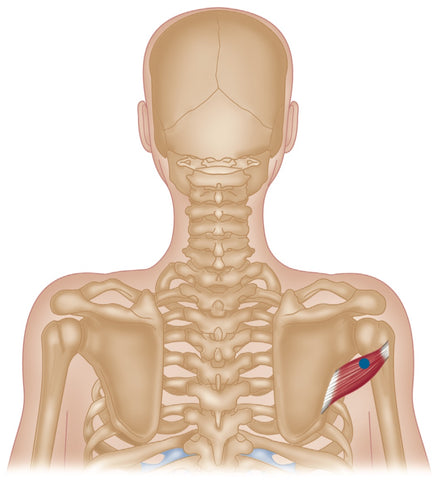
Anatomy
A member of the rotator cuff, which comprises the supraspinatus, infraspinatus, teres minor, and subscapularis.
The rotator cuff helps hold the head of the humerus in contact with the glenoid cavity (fossa, socket) of the scapula during movements of the shoulder, thus helping to prevent dislocation of the joint.
Origin
Upper two-thirds of lateral border of dorsal surface of scapula.
Insertion
Lower facet on greater tubercle of humerus. Capsule of shoulder joint.
Action
As a rotator cuff muscle, helps prevent upward dislocation of shoulder joint. Laterally rotates humerus. Weakly adducts humerus.
Antagonists: subscapularis, pectoralis major, latissimus dorsi.
Nerve
Axillary nerve, C5, 6, from posterior cord of brachial plexus.
Basic Functional Movement
Example: brushing hair back.
Indications
Shoulder pain (especially posterior), frozen shoulder syndrome, rotator cuff rehabilitation, subacromial bursitis, biceps tendonitis, shoulder pain at top outer section of shoulder blade near posterior deltoid, often associated with other shoulder problems (especially rotator cuff issues), numbness/tingling in 4th and 5th fingers.
Note: Trigger points in the teres minor muscle mainly cause a deep pain in the shoulder which can sometimes be misinterpreted as bursitis.
Causes
Reaching above 90 degrees and/or reaching behind back, gripping steering wheel in RTA, holding heavy object for long time, computer/mouse, overuse syndromes.
Differential Diagnosis
C8–T1 radiculopathy. Rotator cuff tendinopathy. Shoulder–wrist–hand syndrome. Subacromial/deltoid bursitis. Shoulder impingement syndromes (painful arc). Acromioclavicular joint dysfunction.
Connections
Infraspinatus.
Trigger Point Treatment
| Spray and Stretch | YES |
| Compression | YES |
| Muscle Energy Techniques | YES |
| Positional Release | YES |
| Dry Needling | YES |
Top Related Videos Because You Liked: Teres Minor
Supraspinatus Trigger Point Release


