


Dupuytren's Contracture
Maureen Abson demonstrates palm massage for Dupuytren's Contracture
Dupuytren’s contracture is a condition that can cause the fingers to contract, sometimes meaning that the person loses normal functioning of the hands.
First, to explore some of the myths that surround Dupuytren’s, this condition is not caused by overuse, operating machinery, or too much golf, nor is it a virus.
Rather it is a thickening of the connective tissue below the skin—but on top of the tendons. In this way it is similar to scar tissue, and as it builds it pulls the fingers forward.
Its exact cause is unknown but it is thought to have a genetic link, so runs in families. It is most common in the hands but can also occur in the knuckles, the soles of the feet, and, for some men, it can develop in the penis, causing a curvature.
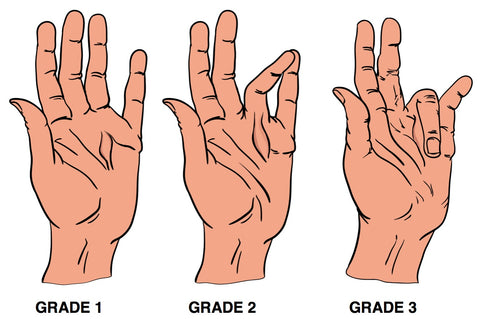
Three grades of dupuytren's contracture have been described (see below)
Three Grades of Dupuytren's Contracture
Three grades of dupuytren's contracture have been described, based on the characteristics of the fibrous tissue deformity and the presence of a contracture.
-
Grade 1: thickened nodule and a band in the palmar aponeurosis that may progress to skin tethering, puckering, or pitting.
-
Grade 2: peritendinous band with limited extension of the affected finger.
-
Grade 3: presence of flexion contracture.
Who's at Risk?
Dupuytren’s contracture is more common in men than women and is mainly a condition of middle age and onward. When women do get it they tend to present less severe symptoms.
Men of northern European heritage seem to be at much greater risk than other groups. There appears to be an increased chance of men with Dupuytren’s contracture also developing diabetes, but this is not yet fully understood.
Symptoms
The condition is normally painless, but is very inconvenient as the affected fingers become progressively and permanently difficult, or impossible, to use.
Surgery is often carried out to release the fingers, but with mixed results. Other specialists recommend injections or radiation treatment, but for some these cause unpleasant side effects.
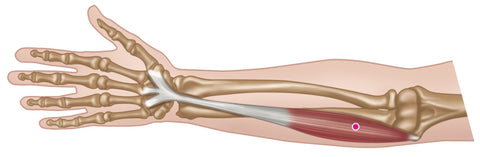
Dupuytren’s contracture - Check for this trigger point in Trigger Point in Palmaris Longus
Trigger Points
Myofascial trigger points in the palmaris longus or other forearm muscles may contribute to either pain or movement restrictions that may exacerbate the fibrous restriction process.
When treating this problem, take care to address the forearm muscles and any other soft tissues of the upper extremity that might also be contributing to further tension in the palmar fascia.


