
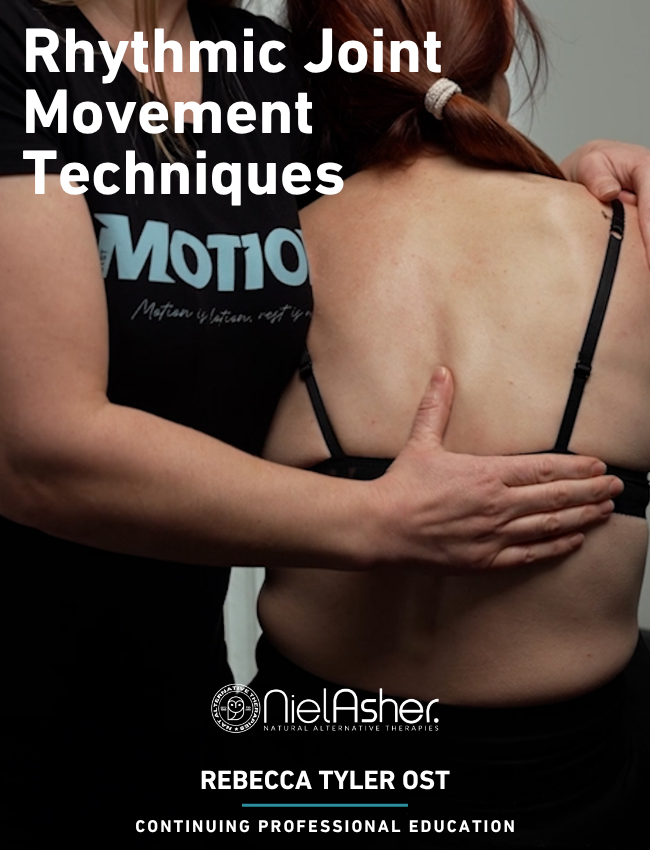
Rhythmic Joint Movement Techniques (6 hrs)
Rhythmic Joint Movement Techniques
6 Hours CE/CPD | Online Manual Therapy Course
Rhythmic joint movement techniques are a gentle, practical, and clinically useful way to assess and improve joint mobility, tissue response, movement quality, and patient comfort.
Rhythmic Joint Movement Techniques is a 6-hour CE/CPD online course presented by osteopath Rebecca Tyler. The course is designed specifically for massage therapists, manual therapists, bodyworkers, and rehabilitation professionals who want to develop a confident, low-force approach to joint articulation and movement-based manual therapy.
Through comprehensive video tutorials and companion course learning, Rebecca demonstrates how rhythmic, low-velocity joint movement can be used across the spine, ribs, shoulder complex, pelvis, hip, knee, ankle, foot, and upper limb. The emphasis throughout is on clinical reasoning, patient comfort, practitioner body mechanics, palpatory awareness, and reassessment.
Course Overview
This 6-hour CE/CPD course introduces the principles and practical application of rhythmic joint movement techniques, also commonly described in osteopathic and manual therapy contexts as articulation. Rather than forcing a joint through range, the practitioner uses comfortable, rhythmic movement to explore restriction, ease, tissue tone, and movement response.
Participants will learn how articulation can be used as an assessment tool, a preparatory technique, a main treatment approach, or a closing integration within a wider session. The course places strong emphasis on working within scope of practice, adapting to patient response, avoiding unnecessary force, and reassessing meaningful change.
The video tutorials provide detailed demonstrations of upper-body and lower-body techniques, while the companion course materials support learning with clinical reasoning prompts, technique maps, reflective questions, and a final course quiz.
What You Will Learn
| Topic | Focus |
|---|---|
| Rhythmic Joint Movement Principles | Understanding articulation as a low-velocity, rhythm-based approach to assessing and improving movement quality |
| Clinical Reasoning | Knowing when to use articulation at the beginning, middle, or end of a treatment session |
| Restriction and Ease | Learning when to work toward a movement barrier and when to move into a position of ease |
| Upper Body Techniques | Applying rhythmic joint movement to the cervical spine, TMJ, thoracic spine, ribs, shoulder complex, elbow, wrist, and hand |
| Lower Body Techniques | Exploring articulation strategies for the SI joint, hip, knee, fibular head, patella, ankle, cuboid, navicular, metatarsals, and foot |
| Safety and Scope | Adapting technique choice, amplitude, rhythm, and positioning according to comfort, contraindications, clinical presentation, and professional scope |
Course Content
The course combines practical video instruction, clinical reasoning, technique observation, patient positioning, practitioner body mechanics, safety considerations, reassessment strategies, and reflective learning.
| Lesson | Focus |
|---|---|
| Foundations: Why Articulation Works | Core principles, clinical use, palpatory awareness, restriction, ease, and reassessment |
| Safety, Comfort, and Practitioner Mechanics | Patient positioning, consent, comfort, contraindications, body mechanics, and efficient rhythm |
| Cranio-Cervical, TMJ, Ribs, and Thoracic Spine | Upper cervical movement, jaw articulation, thoracic mobility, rib movement, and breathing-related reassessment |
| Lumbar Spine and Shoulder Complex | Lumbar flexion, extension, rotation, lateral flexion, glenohumeral traction, and shoulder-girdle articulation |
| Elbow, Wrist, SI Joint, and Hip | Peripheral joint specificity, radial head, carpal bones, SI joint shearing, and single-plane or multi-vector hip articulation |
| Knee, Ankle, and Foot | Knee movement, fibular head, patella, ankle mechanics, whole-foot articulation, cuboid, navicular, and metatarsal mobility |
| Integration and Treatment Planning | Sequencing techniques, documenting clinical reasoning, and connecting articulation to patient goals |
Who This Course Is For
This course is designed for qualified practitioners and students with a foundation in anatomy, palpation, professional touch, and client or patient care.
It is especially suitable for massage therapists, sports massage therapists, manual therapists, osteopathic students, physical therapy and rehabilitation professionals, bodyworkers, and healthcare practitioners who want to expand their joint-based manual therapy skills while maintaining a gentle, patient-centred approach.
Included With This Course
| Included | Details |
|---|---|
| Video Instruction | Comprehensive technique demonstrations presented by osteopath Rebecca Tyler |
| Companion Course | Structured companion learning designed to reinforce clinical reasoning and practical application |
| Reflective Learning Checks | Lesson-based questions to support understanding, retention, and professional reflection |
| Online Exam | Final assessment included for course completion |
| Certificate | 6 Hours CE/CPD certificate following successful completion |
| Online Access | Study online at your own pace through the course platform |
About Rebecca Tyler
Rebecca Tyler is an osteopath, manual therapist, educator, and principal at BTST in the UK. Her clinical background includes osteopathy, sports massage, personal training, swimming coaching, dry needling, and manual therapy.
In this course, Rebecca brings a practical osteopathic lens to rhythmic joint movement, with a strong focus on palpation, patient comfort, movement quality, and clinical decision-making.
Professional Note
This course is provided for continuing education and professional development. Learners must work within their own scope of practice, training, competence, local regulation, employer policy, and insurance or indemnity arrangements. Completion of this course does not authorise practice outside professional scope.